Spreading the Word about the ‘Worlds of Ursula K. Le Guin’ Documentary and Kickstarter Campaign

I recently learned about this feature documentary about Ursula K. Le Guin and the fundraiser that the filmmaker, Arwen Curry, is currently running through Kickstarter. It looks like a wonderful project, and Arwen Curry has been filming and working closely with Le Guin for a number of years; the film is scheduled to come out in 2017.  The project has been awarded a grant from the National Endowment for the Humanities, but to get the funds from the grant released, the producers have to raise the balance of their budget, which is $200,000.  While they set their initial Kickstarter goal for $80,000, they’ve already doubled that, and with two more weeks to go, it looks like there’s a good chance they’ll get the full amount and then be able to focus entirely on finishing the film — I’ve got my fingers crossed that they’ll make it!

As anyone who knows me (or who’s read much on this site) is well aware, Le Guin is both my favorite author and my greatest inspiration as a writer. It may seem that I go on about her a bit much, but it’s hard to put into words the significance of the epiphany I had when I first discovered her work.  As I mention in my bio here, it was because of her that I learned that there was such a thing as social science fiction, and realized that all these story ideas I had running around in my head fit perfectly into that subgenre.  (And one could argue that much of my fantasy is essentially social SF with a fantasy-type setting and a few other elements that give it that fantasy feel instead.)

Because Le Guin writes both SF and fantasy and a wide variety of other things — including poems, essays, plays, contemporary fiction, and children’s picture books — she also provided an example of the kind of writer I want to be, since I’m interested in writing many things and wouldn’t want to be pigeon-holed into any category.  And as soon as I was old enough to fully appreciate the brilliance of her style, it also contributed to inspiring me to strive toward that level of mastery as a writer.

It’s intriguing how a person you’ve never even met can have as much of an impact on you as, say, a favorite teacher, or even a grandparent. When you read someone’s words (and I love reading Le Guin’s essays almost as much as reading her fiction) and find that those words feel familiar yet also teach you new things that relate to your own ideas and goals, it’s a great deal like having a mentor who plays an active role in your life.  It was actually a bit unsettling when I first read Le Guin’s work, because I discovered that some of the elements, such as the settings, the concepts involved, and the type of storylines, made her stories seem remarkably similar to my own.

For instance, much of Planet of Exile and parts of Tombs of Atuan gave me the odd feeling that here was something I could have written in another life, or perhaps in a parallel universe where I was a slightly different version of myself.  But I should also clarify that I’m referring to the content and ‘flavor’ of those stories — not, alas, that I’m suggesting that there was a marked similarity in the writing!  (I only wish I could say that my style was similar to hers when I was a young teenager!) 😉

Funnily enough, much more recently I’ve had the experience of something feeling familiar in the opposite way.  I haven’t read Patrick Rothfuss’s books (I’m afraid I always have a big backlog of books I want to read, just as I have a backlog of stories to write!), but on several occasions I’ve picked one up and read a passage or two.  And each time I’ve come away with the feeling that there are uncanny similarities in our styles — rather than getting the ‘this sounds like something I would write about’ feeling I’ve had with Le Guin’s stories, I found myself thinking ‘boy, that sounds like the kind of phrasing and/or descriptive details I would use’.  It isn’t that anything about the content feels particularly familiar, only the style, and from looking at Rothfuss’s website and some interviews, we don’t appear to have any influences in common — other than Tolkien, which is practically a given when it comes to writers of fantasy.  (But perhaps that’s not insignificant; sadly, I’ve encountered some young fantasy writers online who admit to strongly disliking Tolkien’s style.) 😕

But I also thought of Rothfuss just now because one thing I really admire about him relates to fundraisers; he founded a charity called Wordbuilders that raises money for projects like Heifer International, which I think is fantastic.  Whenever an artist has had enough success to give them some visibility, that visibility may be helpful in raising awareness of a good cause, so it gives me the warm fuzzies to see an author putting so much of their energy into charity work, and Mr. Rothfuss certainly deserves kudos for all he does in that arena.

Le Guin is also someone who’s done countless wonderful things that go well beyond her own writing. She’s always been a vocal supporter of authors and artistic freedom, as well as setting a great example for being open-minded and passionate about the positive potential in all us, artists and non-artists alike.  I confess it’s kind of wild for me to read some of the comments on the Kickstarter page and on Facebook about how she’s inspired and moved other people.  In spite of her stature as an author, the truth is that if I don’t count people I’ve come across on websites that have to do with writing or reading, in ‘real life’ I’ve met no more than half a dozen individuals who knew her name and had perhaps read one of her books.

So in many ways it’s always felt as if my zeal for Le Guin as a writer is a personal thing that’s part of my identity alone, although of course I’ve always known — on a logical level — that it was impossible that I was her only devotee!  It’s always nice to meet fellow fans who share a common interest, but being an author whose own work has been influenced by hers also means that it’s important for me to learn more about her other readers and find ways to connect with them.  One of the obvious answers to the question of who the audience is for my own books is ‘Le Guin fans’; I’m sure most people would identify In the Shadow of the She-Wolf as the same type of literary social science fiction as Le Guin’s SF novels.  (Hey, for that reason alone it’s exciting to see confirmation that the folks who read those books really do exist!)😀

In all seriousness, it’s great to see the depth of support for this documentary and to know there are many of us who are looking forward to it, and I’d like to encourage anyone reading this to contribute to funding the project if you’re able to (and haven’t done so already), and also to pass this along to anyone else you know who might be interested.  Here’s the link to the Kickstarter campaign again.

Copy Editing Humor

When it comes to television, I’m pretty much a PBS addict, but I do occasionally watch other channels. One of my guilty pleasures is watching TLC, since I like some of the programs having to do with fashion, like the makeover shows and shows about wedding dresses.  (I’ve become a fan of the designer, Pnina Tornai — some of her dresses are amazing! — and I named Crea’s cousin in How to Steal a Demigod ‘Penina’ as an homage to her.)  On one episode of Say Yes to the Dress, the sales consultant’s reaction to a comment made by a member of the bride-to-be’s entourage is hilarious.  People can certainly say odd things when criticizing a dress and saying what it reminds them of (or describing what they think the dress should look like), and in this case the odd objection caused the poor consultant to look both confused and exasperated and exclaim, “What does that even mean?!”  The way she drew out the word ‘mean’ for maximum effect made it particularly funny, and also made the phrase and her intonation stick in my mind.

So I’ve been buried in copy edits for the first two volumes of In the Shadow of the She-Wolf, and it never ceases to amaze me how little things can sneak through in a manuscript that’s been picked over and edited many times. Some of those sneaky proofreading errors are fairly understandable, such as a replacement of one word with a similar one that’s still a real word with a correct spelling.  My writing buddy whom I sent an ARC to caught one of those — ‘pouring’ in place of ‘poring’, when it means going over something in detail.  (Like copy edits!)  Since I normally pride myself on my copy editing skills (and the first agent who read a full manuscript of mine commented on how clean that manuscript was), it’s still embarrassing, but it’s not as if that’s a word most of us think about very often.  Much worse — and I have no idea why it wasn’t corrected earlier — was the replacement of the word ‘series’ with ‘serious.’  Three other people (in addition to myself) read that, and not a single one of us caught it?  Seriously? 😉

I’ve come to the conclusion that even the most picky readers (who can be very scathing in their criticism!) sometimes get caught up in the story or are focusing on one aspect of the writing more than another, and miss things that should be obvious. As I mentioned before, some of the little bugs that make me cringe are repetitive things, like the same word appearing three or four times in a paragraph or two when it could be reworded to avoid that repetition, or using the same speech tag or a very similar description of someone’s expression only a few paragraphs apart, even if those things might not really bother a reader who is caught up in the story.  Even more embarrassing is when you come across a sentence or phrase — which might have been intended as a poetic metaphor or a creative way of capturing a feeling, or might just have been something which should have been simple yet didn’t come out that way — and realize you’ve been skimming over it because it seems to capture the gist of what you intended.  But when you take a good hard look at what the words on the page actually say, you find yourself thinking, “What does that even mean???!!!”

White Sky Featured at Speculative Fiction Showcase

White Sky is the featured new release on the Speculative Fiction Showcase today.  This is a great site that features books that have recently been released.  It also has regular posts with an extensive list of links that have anything and everything to do with speculative fiction, including articles, reviews, and interviews with authors.  The gals who run this site do a really nice job, and it’s exciting to have my book included.

The excerpt I chose for this venue is one that hasn’t been posted elsewhere; it’s part of a scene I particularly like, in which Jem first meets the old Torvik rebel, Avakab.  It did occur to me (after the fact!) that someone looking at the blurb and this excerpt together might assume that Avak is the man referred to in the blurb, but he isn’t — while he’s pretty intimidating, he’s not the ‘villain’ in the story.  (Compared with old Avak, that man is, IMO, much less impressive and yet much more sinister!)

Cover Reveal for White Sky

White Sky Front Cover

Here’s the cover for White Sky, the first volume of In the Shadow of the She-Wolf. The cover was ready some time ago, and it’s the final copy edits that have ended up taking more time than I’d anticipated. I’m rather surprised at how many little things I’ve found that I want to tweak in a manuscript that has already been pored over countless times, over a span of many years. (Maybe I shouldn’t be surprised, considering how much of a perfectionist I am!) 😮

One thing that’s made it tricky is trying to approach the edits as if the book were written by someone else, and putting on that last polish — clearing up spots that could be even smoother or clarifying small details — without trying to change the author’s style. Repeatedly trying to update the manuscript to match the growth and evolution of my style is what put me in danger of spending my entire life writing and rewriting the same book in the first place(!), so there had to be a place to draw a line. To find that balance, I’m certainly trying to make the book the best it can be, but I’m also endeavoring to respect the younger version of myself who wrote it. As I once mentioned here, I believe you have to look at it like an artist who can show off their paintings and remark that some were done in their blue phase or their abstract phase — which they’ve moved on from — and still be proud of those paintings and the way they reflect that stage of their journey as an artist.

Having this book published by our own small press has of course given me full control over the cover design, which is something I’d never imagined having, since most publishers don’t give authors any say in the matter.  After years of visualizing this novel in print and imagining a typical SF cover (such as an image of Jem brandishing a Zendi gun, with or without some of the other characters behind him), I was fully reconciled to the fact that it might end up with a cover that’s a bit cheesy (though I’d say some SF covers are cheesy in a pretty cool way!)  With the issue in my own hands, I chose not to go with something that screams SF, but to use a more elegant image that might be equally appropriate for literary fiction, since I think that’s actually a better representation of the final incarnation of the book.

If it were a cover for a literary novel, however, I imagine it probably wouldn’t include the wolf face, only the photo. The shadowy wolf mask represents the entire novel — like a brand — and it appears on all three covers (in different colors). So although I’d originally envisioned more of a large shadow figure looming behind the main image on the cover, when I came up with that idea I realized it would work well for a book in three volumes, helping to tie the cover images together. I’m quite happy with the end result, and I believe it does have the clean, elegant feel I was going for.


The Clarion West Write-a-thon 2015

The Clarion West Write-a-thon, which always runs concurrently with the Clarion West Workshop, starts next week.  While I’ll still be working on the same project (yes, the one I was sure I’d finish drafting last year!), I’m excited and confident that I really will get this manuscript completed soon.  (My only excuse is that becoming one of the owners and editors of a small press last year took up a fair amount of time and creative energy.  At least it’s writing-related, right?) 😛

The other exciting incentive for reaching my goal this year is that in August, shortly after the end of the Write-a-thon, I’m finally going to visit Lassen Volcanic National Park to do research for this book.  This is a trip I’ve been thinking about for years.  (I won’t say how many — I don’t want to give away just how long ago I got the idea for this book!)  The original plan had also included taking a glacier-climbing course on Mount Shasta on the same trip, but for a number of reasons that’s not going to happen; in any case, I’m just thrilled to finally make it to Lassen.

The region that the young hero in the story travels to has lots of volcanic ‘stuff’ (how’s that for scientific terminology?) similar to the features at Lassen.  And the name in the title, Elebfar, refers to the mountain (an active volcano) that’s central both in regards to the location of the latter half of the novel and to the source of the main conflict in the story.  (You can see a little more about the book here.)

Since I’m so obsessed with realism, getting to experience that setting (or re-experience it, since I did visit Lassen with my family once, although I was only about seven) is important to making it all come alive in the book through vivid (and sometimes disturbing!) details.  (And it also has to do with a certain word I like.) 🙂   In any case, I think it’s always great for an author to visit either the actual setting of a story or something similar if the real location is either too impractical or simply impossible to visit.  (And for some reason locations on imaginary planets generally fall into the latter category.) 😉

Queries, Quandaries, and Just Saying No

It’s become common for literary agents to use a ‘no response means no’ policy in which they only reply to queries that interest them and no longer send out rejections in response to all the other queries they receive.  (So if you’re one of those writers who aspires to wallpaper a room with rejection slips, you’re really out of luck now — even with the switch to email over snail mail you could still print them and stick them on the wall, but if you don’t even get anything back . . .  Well, let’s just say you’ll have to find something else to decorate that room with.) 😉

The serious issue, of course, is that most writers find this lack of response adds to their stress level for a number of obvious reasons.  It can make you feel as if you’re sending your carefully prepared submissions out into a void, and you can’t necessarily be certain that your query was rejected; there are always cases where someone receives a request for materials six months or more after they queried.  (Heck, there’ve even been cases where someone got a request after so much time that the manuscript had already been picked up by another agent and published!)  So it makes it harder to get a sense of where you are in the process and how many of your queries are truly outstanding versus those that have probably been rejected.  (But maybe not.)  And unless the agent has an online submission form that confirms receipt, there’s also that nagging question of whether one’s query might have been lost or gotten trapped in an overzealous spam filter.

I’m pretty sure most writers really don’t like this policy — and would choose a definite rejection over uncertainty — but I’ve noticed that when the subject comes up, many people insist that it’s perfectly reasonable, and are quick to point out that of course all good literary agents must devote most of their time to their clients, while they don’t owe queriers anything at all.  Although those things are very true, I don’t believe ‘no response means no’ is a necessary evil we should blithely accept.  Furthermore, all the emphasis on the need to be thick-skinned shouldn’t stop us from being sympathetic to writers who find the process exasperating.  Neither should we refrain from engaging in conversations about whether there might actually be ways to improve the situation.  So while it’s not my aim to ruffle any feathers, and I won’t say that ‘non-respondence’ is necessarily a sloppy or unprofessional practice (as some people will suggest), I will say that I think there are other ways to manage the situation that are more professional as well as more considerate.

Frankly I haven’t seen compelling evidence that supports the idea that ‘no reply means no’ is the only practical and efficient method for agents to handle lots of queries.  To begin with, there’s the hard-to-miss fact that there are some very popular agents (i.e. ones who definitely receive a high number of queries) who do consistently send replies (even if they’re mostly brief forms), and some of those agents are also very rapid responders.  One argument that I just came across is that if an agent takes ‘a minute’ to reply to a query, responding to a hundred and twenty queries would take them two hours.   But this calculation is based on an honest mistake.  We often say ‘one minute’ without meaning it literally, but  it really doesn’t take sixty seconds to read a query, much less to send an email reply — it can take as little as ten or fifteen seconds.

Out of curiosity, I did an experiment and pretended to be an ‘old-fashioned’ agent handling snail mail queries.  I timed it, and determined that if I were one of those agents who would write a quick note on the query itself and send it back (a bit off-putting, perhaps, but there certainly were — and probably still are — some agents who would do that to save both time and stationary), I could take an envelope from the inbox, slit it with a letter opener, pull out query and SASE, read the entire query, scrawl ‘Not for me, thanks’ at the bottom of it, put it into the author’s SASE, and drop the sealed envelope into the outgoing mail pile within thirty seconds.  And if the query were an obvious dud so I didn’t get more than halfway through the second paragraph before I stopped reading (and theoretically that’s true of eighty percent of any slush pile), I could do it in twenty seconds.

Doing this via email and avoiding the physical paper shuffling clearly makes it even faster.  My sister has worked as an executive assistant for many years and learned to deal with a staggering volume of emails every day.  I know from what she’s told me that there are tools for managing email to make it more efficient.  So if you set it up properly, with just a couple of clicks of the mouse you should be able to send a form reply (and I believe it’s possible to make a choice between several different forms as you do this).

[ETA: After I wrote this, I discovered this post by Janet Reid from a few years back.  Being an agent herself, she can be blunt about why she feels there’s no excuse for not replying to queries.  And she confirms what my sister said about email — that it can easily be set up so you can select from several standard replies — and says that it only takes her three seconds.  (And, not surprisingly, it turns out that Ms. Reid also follows a practice similar to Ginger Clark’s by reporting how far along she is in queries, which I talk about below.) 🙂 ]

Now of course agents aren’t always going to rush through reading queries; no doubt some take a break from dealing with contracts and such by perusing queries at a fairly leisurely pace, rather than getting them out of the way as quickly as they can.  But for the sake of argument, let’s say it’s reasonable to assume that an agent we query is going to grant us thirty seconds of their precious time (especially after all the time and effort that went into writing that query!).  So why would anyone say it’s unreasonable to expect that agent to take another three seconds to send back a response?  (Granted, there’s the issue of those unpleasant characters who do their best to spoil everything for the writers who are polite and professional by reacting badly to form rejections, but who’s to say they won’t react badly to being ignored as well?)  [Janet Reid also dismisses this excuse in her post.]

Secondly, if an agent is flexible and creative, there are other ways of communicating with queriers even if they’re still determined not to send rejections.  One of the things that frustrates writers is not knowing when to ‘close’ a query and count it as a rejection.  Some agents mention an average response time on their website, but plenty of others say nothing about it.  So the speculation begins: four weeks? six? eight?  What if the agent is out of the country or taking personal leave?  How does the time of year, the holidays, the weather, etc., affect the response time?  But there’s actually a very easy fix that eliminates all of that guesswork.

Although agent Ginger Clark doesn’t send any kind of reply unless she’s interested in a query, she utilizes a system where she regularly posts on Twitter to say that she’s read all the queries she’s received through a specific date and time.  Now I don’t know if there are many other agents who do this as well — it’s not exactly rocket science to figure out that it makes good sense — but considering that the vast majority of agents today seem to use Twitter regularly, you’d think there’d be plenty of them doing it.  But if there were, I’m also pretty sure that everyone would be talking about it rather than speculating on response times.  In addition, while Ms. Clark often travels to conferences and such so she can’t necessarily say she will always get through queries within a certain time period, her method completely removes that problem.

Now I don’t go stalking agents on Twitter or anywhere else, and I can assure you that I’m not giving Ms. Clark a plug because she’s one of Le Guin’s agents.  The significant thing is that her being on my list (naturally) means I’ve researched her, which included browsing her Twitter account, and that’s how I learned of her query reporting technique.  And this brings me to one of my big pet peeves, and something that contributes to the overload of queries that agents receive: writers who query without doing thorough research on all the agents on their list.

Let’s say you’ve written a GoT style epic fantasy intended for an adult audience.  If you hop on Query Tracker or Agent Query or any other online database that lists literary agents, and search for ones who rep fantasy, a list of over a hundred agents pops up.  And you think, ‘Wow!  Look at all the agents I get to query.’  Not so fast.  Fifty of those agents may be on that list because they handle YA and/or MG fantasy, but not adult fantasy.  Or it might be something of a mystery why they’re even on the list at all — it’s possible they mostly rep Romance and don’t work with straight up speculative fiction, but if they marked on some questionnaire that they’re open to paranormal elements in Romance, that might make them show up on the list of agents who rep fantasy.

So how do you know?  You go to each agent’s website and read it carefully to see what they’re looking for.  If they have one, you also visit their blog page, peruse their Twitter feed, and try to find at least one interview with them.   Yes, it takes time, but why would you want to bother a busy person who’s trying to do their job in order to show them something they have specifically said (in a public source that everyone has access to) that they don’t want to see?  Maybe you have a MG fantasy about trolls, and in a brief interview on some author’s blog you discover that Agent X despises trolls — well, you can scratch her off the list for that manuscript.  I would think all this is common sense, but evidently it isn’t.  And, sadly, those who don’t go through this process are essentially helping to gum up the works for everyone else.

I admire agents very much not only for managing all the unpleasant contractual and legal aspects of  publishing (though I’ve studied business law I despise’ legalese’), but also just for continuing to read all those queries.  In the long process of learning everything I can about how to write an effective query and trying to help others by critiquing their queries, there are times when I’ve felt absolutely sick of looking at queries, and found that they all started to sound alike . . .  To be honest, I’m not sure how agents do it.  Last year I became one of the owners and editors of a new small press, and when we start taking submissions I’m seriously considering telling authors that I don’t want to see query letters, only a bare-bones cover letter and the first five or ten pages.

Since one of the reasons we started the press was seeing a need for publishers who don’t emphasize content at the expense of style, we’re looking for books in which the language itself is as important as the content.  So naturally I’ll be looking hardest at those pages, and if I like what I see, then I can ask for a synopsis and find out if the story actually has a functional plot as well. 😉  In any case, if the writing were functional but nothing special, the project wouldn’t fit into our niche anyway, so there doesn’t seem much point in torturing myself by reading query letters.  (And yes, I know — no matter how much we go on about how we’re seeking books written in good old-fashioned lyrical language, some fool will send us a Lee Child style thriller, and I’ll look at the opening paragraph and say, “And why exactly did you submit to this press . . . ?’)

One of the things that made me aware of how many people don’t do their research is reading ‘Ten Queries’.  An agent who regularly does that on Twitter is Margaret Bail, who I’ve also researched because she was on my list.  And it’s mind-boggling how many queries she passes on because they’re in a genre or age category she doesn’t represent.  (When they say ‘query widely’, that’s not what they mean, folks!)  For instance, she doesn’t rep literary fiction, but for some inexplicable reason people still query her with literary novels.  (And if you’re reading this and you’re one of those people, let me say this: Yes, you’re an idiot. And please don’t do it again.)  But what I learned from reading some of Ms. Bail’s Ten Queries comments actually led me to take her off my list.  And no, she didn’t offend me in anyway — far from it.  What she did was clearly communicate her tastes.  And because I have the utmost respect for her and appreciate that she’s taken the time to not only give us some insight into her thought process but also show us just what she is and isn’t looking for, I’m not going to waste her time or mine.

As Ms. Bail’s ‘Ten Queries’ comments not only confirmed that she doesn’t rep lit fic (among other things), I also saw that she passed on some genres that she does rep because she said something about the style being too literary.  After seeing that kind of comment for the third time, I knew I needed to drop her from my query list.  While I’ve always seen Margaret Atwood’s work referred to as literary/SF cross-over (perhaps because she objected to it being labeled science fiction?), Le Guin has always been considered an SF and fantasy writer (and has never objected to that, even thought she writes a very wide variety of things).  But recently I’ve seen Le Guin’s classic SF novels also described as cross-over between literary and SF.  And if that’s the case, I’ve probably shot way past ‘literary style’ or ‘literary bent’ and all the way to cross-over as well.  So although Ms. Bail certainly handles SF and fantasy and I write SF and fantasy, why would I query her with a book written in a style that she’s made perfectly clear is just not her cup of tea?

I think it’s pretty apparent that communication is the whole key here.  That includes taking the time to put the communication out there and making the effort to read and understand the sources of communication that others have made available.  So, for instance, if an agent wants to follow Ginger Clark’s example and keep querying authors from being left in the dark, even without responding to most queries individually, all they’d have to do is to add one little line on their website that lets authors know that they will post updates on Twitter (or another social media site, or perhaps the blog page of the website itself), and then every few weeks or so let everyone know where they are.  (The more I think about this method the more I think it’s a very obvious solution that should be widely imitated.)

Like everything else, the business of querying agents is an evolving process, and there’s a learning curve involved as agents figure out the best way to handle the changes.  The transition to predominantly email queries has been pretty rapid, and it’s no surprise that it’s evidently increased the amount of queries they receive exponentially.  (And with it taking so much less time, effort, and resources to send an email query vs. a snail mail query, no doubt it’s also increased the number of crazy folks who send out queries whether or not they’ve even written a book!)  So I think it’s important to keep an open dialogue going about the process, and not just shrug and blindly accept the frustration as if there’s no possible alternative.  Writers should feel welcome to take part in that dialogue, and no author should be shamed and told they’re whining or being unrealistic if they speak up to say that something doesn’t seem right to them.  Acceptance can also be a form of apathy, and there’s no reason to give up on trying to make a tough process easier for everyone involved.

Seven Reasons for Taking the Plunge

I thought I would share the laundry list of reasons for choosing to undertake the publication of my three-volume SF novel, In the Shadow of the She-Wolf. Though some aspects of the situation I found myself in with this book are probably uncommon, I’m sure the issues I’ve considered here may strike a chord with many other authors.  Some of those issues relate to market-related challenges, others are mostly personal, and some are a combination of both.

There are at least two things that make the situation surrounding publication of She-Wolf unusual.  The first is the amount of time I’ve spent working on this story; I’ve been pulling this book out and rewriting it on and off throughout my entire adult life — ever since I wrote the first sparse draft during my last year in high school — and that affects both my relationship with the novel and how much patience I have for the process at this point.  The second is that I’m one of the owners and editors of a small press.  Although I started the press last year with a couple of my siblings (and we’re beginning by publishing several of our father’s books as we learn the ropes), it is a bona fide independent press that will hopefully publish the works of many authors over many years.

While it was in the back of my mind that it would make it easier if I chose to go that way at some point, the business was definitely not created for the purpose of publishing my own books.  So in a sense, having our press publish this novel is a hybrid between being published by a small press and self-publishing, making it like becoming a hybrid of a hybrid.  (Maybe that’s a ‘double hybrid’? Or a ‘hybrid squared’?)  In any case, it also means I’ve already started to acquire a bit of experience in book publishing, and I’m not doing it on my own.

Most writers are very curious about statistics when it comes to querying (and anything else involved in the pursuit of publication), so I’ll attempt to recap the querying history of this novel. If I go all the way back and include my first attempts at querying early drafts of the manuscript (starting when I was in college), I believe there have been four different times when I sent out at least one query for the manuscript and then stopped querying it.  In the first instance, I quit after about half a dozen queries because I realized I could make the book better and I wanted to do more revisions (which is a wise decision when you’re only twenty). When I next tried querying again, the first (and only) agent I queried at the time (who was my ‘dream agent’) gave me detailed feedback on the full manuscript.  Although I agreed with most of her concerns, I couldn’t figure out how to tackle a couple of the essential ones, and it took me over a year to get the inspiration I needed (and that led to one of several major rewrites).

And in the most recent round, (after many more drafts in which the story grew longer and was eventually split into three volumes), I pulled the first volume from querying after going through only a quarter of the fifty agents on my list.  (Incidentally, that list included some long shots, as it wasn’t too easy to find that many agents who rep adult science fiction — many spec fic agents are now focused on YA.)  The total count in the final round was fourteen queries sent, with eight form rejections, five non-responders, and one request for a full, which was ultimately rejected with some brief feedback (and that feedback implied that the agent was actually unfamiliar with the authors I’d used as comps, and consequently had expected a different style of SF).  Then, for the last time, I stopped sending out queries when I realized that continuing to put the time and effort into the querying process for this novel just didn’t feel right — and what follows are some of the reasons for that. 


1 ) We’re not immortal.

That may seem like a pretty obvious statement, but when you have elderly family members and want to make sure they get to see at least one of your books in print and enjoy it, the glacially slow pace of the publishing world, on top of the uncertainty, becomes a pretty big incentive to find a different way to make it happen. (Not to mention that when many people who know you are aware that you’ve been working on a novel for many years, it’s only natural for them to start wondering why they’ve never seen it.)

2) You can’t spend your whole life writing one book.

After having spent more time on this project than anyone should ever spend on one novel, being able to put it behind me and call it ‘done’ has become a major priority. Most people agree that one of the best ways to grow as a writer is to write lots of books and not dwell too long on any one project.  Although I’ve also worked on a number of other manuscripts over the years, the fact that I’ve always kept coming back to this one, (and kept thinking about this one), has definitely slowed me down a great deal.  I need to get out from underneath this book and shift my focus to all the other novels I already have in the queue (in various stages).  So the sooner I can finish this one for good, and no longer have it hanging over me, the better.  (The title is apparently appropriate on an extra level, as I think I’ve been living ‘in the shadow’ of this book just as much as the hero lives under a shadow in the story!)

3) An author’s style evolves — especially a young author’s. (Or ‘This one needs to be first’.)

One suggestion that’s often made when something about a book makes it difficult to sell as a first novel (such as the word count) is to set it aside until you’ve sold another book or two, and then come back to that one. With this novel, I realized that wouldn’t be a workable solution for me.  In addition to the fact that I’ve been visualizing this as the first one I would publish for many years, the evolution of my style would make it seem a bit odd.  I’m not wild about the idea of putting out a couple of novels that are more mature and sophisticated, and then following them with a work that represents an earlier phase in my development as a writer.  Sure, I know that’s happened with many author’s books, and it’s also possible that many readers wouldn’t really notice — but I would.

I do need to make one thing clear, however. I am not recommending that anyone publish something they wrote when they were young and expect its shortcomings to be excused because it’s a first novel and represents their early beginnings as an artist; many writers regret getting carried away with youthful enthusiasm and publishing something that becomes an embarrassment to them down the road, especially now that self-publishing is so easy.  The reason I couldn’t put this manuscript behind me by ‘trunking’ it was that I’m sure it’s a darn good book (in spite of its painful and protracted birth), and even if it might not be something I would write today, I’ll never look back at it and be embarrassed by it. (Incidentally , it evolved from my third attempt at a novel, not my first, so I’d had a fair amount of practice at novel-writing even before I started the first draft.)  In short, I would not be doing this if I weren’t confident that the writing and editing are at a professional level, and that this novel is every bit as good as the majority of the science fiction novels put out by the big publishers.

4) Agents and editors need authors to be open to revisions.

This is an issue that normally shouldn’t be a bone of contention. The only reason it’s a problem in this case is that ‘I’ve already spent so much time on this book’ situation.  As I thought about the process, it occurred to me that if an agent were to request any structural revisions, I probably wouldn’t want to do them, even if I felt they were really good ideas.  Because this book has already undergone multiple rewrites involving structure and content, I really don’t want to do it all over again with the same manuscript (refer back to #2).

Part of what makes repeating that kind of editing unappealing is that each time you think you’re done with that phase, you subsequently spend a lot of time and effort polishing the language (especially if you’re writing literary fiction or genre fiction in a literary style). So it’s a lot like building a brick wall and then painting a beautiful mural on it.  If you keep taking the brick wall apart and rebuilding it, you’ll have to do parts of the mural over again.  If you do that too many times, pretty soon you‘re not going to get any more artists who want to sign up to paint that mural; they’re going to look for another wall to paint on.

So while I knew I’d be fine with ordinary copy edits — i.e., suggestions for changes to the wording here and there, or perhaps toning down the invented slang — I realized I didn’t even want to think about more significant changes.  (And to a certain extent, any time you show a manuscript to someone new it means the possibility of stirring up the pot.)  But I definitely wouldn’t want to start off on the wrong foot with an agent or editor by being inflexible.  Obviously it’s very important that when an author begins to work with an agent, they show that they’re open to suggestions, and the agent is also going to want to see the writer demonstrate strong revising skills.  (I’ve read that some authors spend a year or more doing a major overhaul of a book under their agent’s guidance before the agent decides the manuscript is ready for submission to editors.)  So that seemed like a pretty compelling argument for no longer trying to get an agent involved with this book.

5) Unless an author has already published a few novels and gained some clout, many sources say it’s impossible for them to sell books that fall outside the accepted word count limits and equally impossible for them to sell multivolume books such as trilogies. (Though evidence suggests this claim may be partly mythical.)

It’s no secret that word count limits are very restrictive in publishing today. I’m pretty sure that nobody talked much about word counts back when I first learned about the basics of querying, because it wasn’t considered such a big deal; a novel was as long or as short as it needed to be, and all you needed to know was that anything over 40k words qualified as a novel.  But, undoubtedly because of publishers’ current emphasis on economic concerns, they’ve figured out what length of book is most cost effective to produce and distribute, and they want to avoid books that fall outside that range unless they’re written by an author whose works are guaranteed to be big sellers regardless of the length.

And while some folks will suggest breaking up a longer work into multiple books, plenty of others say that’s no solution either. Now I’m a bit suspicious that this is one of the countless myths perpetuated on writer’s forums, because whenever I look at the new releases in the SF/Fantasy section in bookstores, there are quite a few that are clearly presented as a debut for that author and also say right on the cover ‘The Saga of So-and-So, Book One ’ or ‘The First Installment of the Chronicles of Such-and-Such.’ Granted, these tend to be in fantasy more than in SF, but some are SF books as well.  Based on that observation, it seems it’s not as difficult for a new author to sell a trilogy as many would have us believe. Still, it does give one pause when so many people keep insisting that it can’t be done.

6) Many editors (and consequently agents) are wary of anything that doesn’t fit into conventions and norms of structure or style.

The obvious stumbling block with this novel is that it consists of three volumes (I don’t personally consider it a ‘trilogy’, but that’s another issue).  As discussed above, some people are adamant that the privilege of being allowed to spread a story over multiple volumes is only granted to well-established authors.  But added to that issue is the fact that the opening section of She-Wolf (the first several chapters) takes place twenty years before the rest of the book, and has a different POV character.  (Though the main character in the novel is present in those chapters, he doesn’t do much — it’s pretty hard to do much when you’re very small, enclosed in a dark space, and mostly sleeping!)  And when you consider the current widespread prejudice against prologues, I can easily imagine that some people would have a very negative knee jerk reaction to this. (The fact that it’s not exactly a prologue — or, it’s a lot more than a prologue — might only make it worse.)  But the last thing I want to do is to argue with anyone about it now — it is what it is.  The opening grew out of the natural evolution of the story, and once I realized that the novel tells the story of the hero’s mother as much as it tells his story, I knew it was there to stay.  (I talk more about this aspect of the story here, and also in the comments I posted here.)

One way I like to describe it is to say that Jem’s story is framed by his mother’s story. Even though it doesn’t shift back to her POV, the end of the novel is focused on what happened to her and why, and on her son’s role in uncovering the truth behind her fate.  And no doubt the people who would object to this structure even if the entire novel were in one volume are probably going to object to it even more when it’s spread over three books, since the reader doesn’t learn the full significance of everything in the opening section of the first book until they get to the end of the third one.  But I still feel that this structure works for this particular story, and in any case, there’s no way I’m changing it at this stage of the game (once again, refer back to #2).

Another thing that could be considered a challenge to traditional publication for this novel is simply the issue facing most of my work: I write speculative fiction in a style that’s generally associated with literary fiction. Most agents and editors like to see books that are sure to have widespread appeal, and in SF and fantasy that often means fast-paced action-adventure stories told in a very plain, accessible style.  (Let’s face it — people may gush over writers like Le Guin and shower them with awards and accolades, but authors who take after Suzanne Collins instead are going to sell a lot more books in the short term, and short term profits appear to be the primary goal in publishing today.)  So while this is something I’ll always have to deal with — and I can only hope there will always be some people who truly appreciate literary speculative fiction — when you add that hurdle together with the ‘undesirable’ structural elements of this novel, the reality is that there’s a good chance it was going to be a hard sell for many agents.

7) There are some advantages to being ‘in control’.

On top of not having to worry about the possibility of getting embroiled in more revisions, taking on the publication of a book yourself means not having to deal with things like having the title changed or ending up with a cover you don’t like. (In the world of traditional publishing, authors typically have no say whatsoever when it comes to the cover.)  So while this is a minor issue for me, it is kind of nice to be able to make those things fit one’s own vision for the book.  For instance, selecting the cover myself means I can choose an elegant image that I feel would also be appropriate for a literary novel, and in the end I think that will fit the story better than a conventional SF style cover that might give some readers the impression that the book is plot-driven space opera.

Being in control of the process also seems like a good option for a three-volume book for this reason: you can bring the volumes out one right after another, and not worry about frustrated readers losing interest when they have to wait a year for the next installment.  Though there are now some exceptions, in which the publisher speeds up the release of multiple books in a series, the traditional publishing schedule has usually meant that it takes a year or so to produce each book, even if the author already had the next book written before the first one was released.


So there you have it. Is it scary to dive into such turbulent waters?  Absolutely.  In some ways it’s terrifying.  Especially since I believe that this novel is far too good to not be taken seriously, and that’s a real risk here.  But the most important thing at this stage of my career as a writer is to move on and put my energy into working on all those other books.

The Ace in the Hole – Going Hybrid

There’s been a lot of talk about hybrid authors in the last few years, and I’ve noticed that a number of authors who’ve had real success with their traditionally published works have also chosen that option, as well as writers who are just starting out. A hybrid author, for anyone who’s not familiar with the term, is one who has some books published traditionally — i.e. by a major publisher that only works with agented authors — and also self-publishes some of their work.  (It doesn’t mean a wicked fairy turned the writer into a Toyota Prius.) 😉

It’s certainly always been my plan to pursue traditional publication for all of my novels. Maximizing the exposure as well as the recognition for every book is very important to me.  (It also matters when it comes to things like the chance of being nominated for major awards.)  But around the same time that I started seeing frequent references to the hybrid author concept, I also discovered — from perusing writers’ forums, blogs, and other online resources about writing — that the traditional route to publishing has become even more uncertain.  After all the years of being told by countless people that if you’ve written a really good book, it will definitely sell, it was a big blow to find out that it isn’t necessarily true.  The reality is that no matter how good a book is, it doesn’t guarantee that you’ll find an agent who wants to represent it.  This is because an agent may honestly love your manuscript but decline to take it on if they don’t feel it’s commercially viable enough to sell to the publishers — and the big publishers have become extra cautious for purely economic reasons.

When I learned this, I realized that having the hybrid option out there — and knowing that it has become more respectable and more widely accepted — is the ace in the hole. By that I don’t mean something secret that you’re holding back, but something you can fall back on if things don’t go as planned, especially when you’re undertaking a risky venture. And it’s a backup plan that makes all that uncertainty less nerve-wracking, because it means that if you’re unable to sell a book you really have confidence in — perhaps only because the agents or editors are too worried that it may not have broad commercial appeal — it doesn’t have to be relegated to the proverbial trunk after all.

Both eBooks and POD (Print on Demand) publishing are instrumental in making self-publishing viable for authors, because setting up books in those formats and making them available to purchase can cost next to nothing (although it may involve a bit of a learning curve if you want to do it well). I understand the perspective of those who see big companies like Amazon as part of the mechanism that over-commercializes everything — which contributes to the value placed on books being determined by their profit-making potential, rather than by any measure of intrinsic worth.  However, the flip side is that the economy of scale available to a huge corporation is part of what makes things like POD publishing accessible to everyone.  That, in turn, makes it possible for artists to fight back against the system by giving them the option of putting their work out into the world themselves. So it’s certainly a complicated situation (and I hate to see big businesses pushing out small businesses, like independent bookstores, as much as anyone), but the upside has to be the variety of options we have now.

One issue that muddies the waters further is that the ease of self-publishing means a staggering number of books are put out before they’re ready, whether they simply suffer from poor editing and presentation, or whether the author is so green that their writing is years away from being presentable. And all of those sadly unprofessional books that clutter the market can be seen as giving self-publishing a bad name.  So this contributes to the reason that many still refuse to give self-published books the same respect as traditionally published ones.  But, as I’ve seen pointed out numerous times, there have always been plenty of lousy books put out by the big traditional publishers as well!  And one positive thing that can be done is to educate authors and help them understand that it’s not to their benefit to rush into self-publishing (or querying agents, for that matter) before they’ve put in the time to acquire solid skills — and before they’ve gotten honest feedback from others confirming that their work is truly ready for publication.

Another warning authors may hear is that if they put a book out and it doesn’t sell well, potential agents and publishers considering their other works may be put off by their low sales record. But to be honest, I would be skeptical of anyone who took a hard line on that subject, because it seems both unfair and illogical.  Common sense would dictate that any reasonable person would take into account how the book was put out and what kind of publicity and distribution were involved.  If it were self-published or published by a small indie press that expected the author to do all the publicity themselves, even if it only sold half a dozen copies it might be no reflection on the quality of the book at all.  It might be a really good book, and the author might be a really good writer.  But they might also be someone who couldn’t sell a bucket of water to a man whose pants are on fire, in which case it would be quite unrealistic to blame the lack of sales on the book itself!

Obviously if an author already has an established fan base from previously published books, or some other kind of solid platform that ensures they’ll have readers lined up, it makes choosing to self-publish less of a risk. And there are plenty of other factors to consider as well — for instance, if the author has contacts with others who have the skills to help with editing, proofreading, cover design, or marketing and promotion, it can make the whole process much easier, as well as making it less of a gamble.

Of course, whether or not one has those advantages, this isn’t a decision to be taken lightly, nor an excuse to cut corners and publish work that isn’t of a professional quality. But when you also consider that we could miss out on some wonderful stories that don’t make it through the traditional grind for reasons that have nothing to do with whether readers would truly enjoy them, having another option is definitely a positive thing.  So while there’s no question that there are many issues that have to be weighed in making that decision, there are times when self-publishing may be the best choice for a particular book.

In my next post, I’ll explain why it seems the best route for one of my novels (or three, depending on how you look at it), and why I’m taking advantage of this option sooner than I’d imagined I might when I first learned that it could be a legitimate alternative.

Story Out in Debut Issue of Straeon

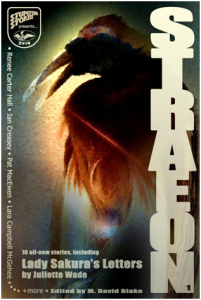
Straeon CoverI’m excited to report that the first issue of the anthology, Straeon, edited by M. David Blake, has finally been released.  It includes my novelette, “Rains of Craifa, Figure 1 – Girl with Shavlas”.  (Just in case you’re wondering, a novelette is a long short story between 7,500 and 17,500 words.  Another FYI — while the following discussion relates what inspired the story and discusses several facets of the theme, it doesn’t include any spoilers. ;))

This is a story I wrote a number of years ago (like many of my writing projects), and it was originally entitled “Rainy Season”.  The title was changed because — not surprisingly — that one has already been used numerous times.  It’s also a positive change since I like how the new one adds a little extra to the story by providing a hint about what happens afterwards.  Also, although some of my own titles are simple, I actually have a fondness for long, elaborate titles, both because they are so distinctive and because they may be quite poetic as well. (A couple of memorable examples I often think of are Delany’s “Time Considered as a Helix of Semi-Precious Stones” and “Stars in My Pocket Like Grains of Sand”; Harlan Ellison has also had quite a few very long and very unique titles that are pretty tough to forget.)

Naturally one of the advantages to pulling out a story after having not looked at it for some time is that it helps you view it objectively. (As I get older I seem to find it easier to do that even if the manuscript in question has only sat for a couple of months . . .  I’m not sure if that’s a good thing or not!  ;)) Being objective also helps make one more aware of things like symbolism. When my sister was studying Literary Criticism for her MA in English and showed me some of her assignments, I confess we laughed over how the serious critics often dissect a story in such depth that the resulting analysis seems absurdly elaborate (and sometimes rather far-fetched).  The ‘lit crit’ folks would probably have a field day with this particular story, as there are many layers of symbolism and many ways in which all the elements tie together.

As I noted in a previous blog post, I find it fascinating that a lot of symbolism comes from the writer’s unconscious mind, rather than being deliberately included during the process of writing.  Certainly I was aware of the basic elements of the theme I was exploring in “Rains of Craifa” involving the transience of life and beauty, like the lyrics of Nino Rota’s “What is a Youth?” from Zeffirelli’s Romeo and Juliet.  But many of the additional layers and details that feed into that theme came as a surprise to me, since I only realized they were there while wrapping up the final edits.

When I was inspired to write “Rains of Craifa” I’d been thinking about Bradbury’s “All Summer in a Day” — specifically, the idea of a place where something only happens briefly and very infrequently, so that if one misses it they may have lost their only chance to experience it.  Clearly that concept can be seen as a metaphor for life itself, and how important it is to ‘seize the day’. (Although in Bradbury’s tale I see that as a secondary theme, while the main subject, IMO, is how children can unintentionally be very cruel.)

The other inspiration that fueled “Rains of Craifa” was a scene in a nature program that showed a frog that spends the dry season looking like a knot of wood on a branch.  Only when the monsoon rains arrive does it transform back into a living, hopping frog, as if magically freed from a spell by the kiss of rain.  And I started thinking about how it might feel to live that way, which in turn led to speculating what it would be like if there were people with a similar life cycle.  So again the ‘carpe diem’ theme and the notion of a brief window of opportunity came into play.

From the first draft one of the things I liked about “Rains” is that I believe it truly captures what travel feels like.  Part of that is the curious sense of obligation — almost guilt — that most travelers feel about seeing and doing the things they’re supposed to do when visiting a certain place.  I.e., when you visit Paris you have to see the Eiffel Tower, when you come to Arizona, you have to go to the Grand Canyon, when you’re in Venice you have to ride in a gondola.  While writing this story I certainly thought about how the fresh perspective provided by traveling can shake someone who’s depressed out of a rut and help give them ‘a new lease on life’.  However, I hadn’t considered how that feeling of being obligated to do certain things when you’re only in a place for a certain period of time is also parallel to completing a bucket list during one’s life journey.

And again, while the issue of becoming depressed and withdrawing from life was always part of the overall theme in “Rains”, that element wasn’t fully developed until my final edits came together shortly before I submitted it.  Then I could see how the story succeeds in conveying how a state of depression can feel like being alive without experiencing life.  But that, of course, is also like spending your existence in a dreamless sleep, as one might do if one truly estivated like a frog through a very long dry season.

While I was partly conscious of the extra symbolism involved in seeing a politician without a face in the opening scene (since their face, i.e. their image and the need to be identified as someone well-known, is a crucial part of their very existence as a political figure), there are other more appealing details that I’m certain I didn’t make a conscious choice about.  One of those is the pervasiveness of autumn colors in the story.  Only recently did it occur to me how much those colors add another nuance of meaning, since the falling leaves of autumn are also a blatant symbol of mortality.

The passage that I’ve always been most proud of in this story (and the one that gives me the ‘Wow — did I write that?’ feeling) is the dream sequence near the end that’s featured in the excerpt I posted on my Short Stories page.  So it’s neat to look at it now and start seeing numerous details that any academic-style critic might easily harvest out of that scene.  For instance, the brown river, being brown like the earth and flowing like the passage of time, is also a metaphor for mortality.  When the river is carrying Valco away on the boat and the girl is left behind, it’s because she seems suspended in time.  But the brown cloth wrapped around her is the same as the river, for she, too, is mortal, and caught in the inevitable flow.  And in the dream the colors of autumn are all around them.

White birds invariably represent something transcendent — something outside of the mundane world.  It’s no surprise that in many cultures white birds are associated with the heavens, peace, purity — concepts that seem above and beyond the earth, since not only can birds fly into the sky, but the stark contrast of their white plumage against the colors of the ground, the plants, and most other living creatures makes them seem untouched by all those earth-bound things.  So with that transcendent quality, here they also represent that moment when you step outside of the inescapable flow of mortality by existing fully in the present as you experience joy and beauty.

I’m sure others can find plenty of additional symbolism that I haven’t seen myself, but finding those elements in that scene was particularly fun.  Incidentally, the most difficult thing about working with this story was that I was always pleased with the last few pages (the dream scene and most of what followed it), but each time I’d reread it and then flip back to the beginning, the opening seemed to lack something in comparison.  To be honest, the ending is still my favorite part.  But in doing the final edits and having the benefit of the input of a skillful editor (thank you, Mr. Blake!), the pieces came together well enough to make me feel confident that it’s a successful story overall.

Though the hypothetical ‘perfect’ story — in which not a word could be altered or replaced without losing something, and each and every sentence reads like an exquisite line of lyric poetry — must be the elusive grail to strive toward, there’s always a special satisfaction that comes at the moment when you can see that in weaving together a collection of words you’ve built something whole that feels like an entity in itself.  (And to me, no story is finished until it’s published, because until that point it’s fair game when it comes to revising and editing.)  But what really gives a completed story meaning is having the opportunity to share it and know that what you’ve made may give others a memorable experience, however briefly.  So I hope many readers (even if they’re not inclined to go digging for symbolism in every line!) will find something in this story that speaks to them.

Using a Logline to Build a Query

After delving into loglines and discussing what I’ve learned about them (here and here), I thought I would try illustrating how one can use a logline as the foundation for constructing a query.  One problem we often see when writers first attempt a query is that they throw in everything but the kitchen sink — names of numerous characters, places, and objects, an entire paragraph of back story, a long synopsis-y description of the plot that tries to bring in all the secondary plot lines, etc..

The key is finding the central plot line and choosing the most significant elements to focus on, and then developing that enough to make it both clear and intriguing, without trying to include and explain everything.  What makes this far more difficult than it sounds is that when you’re looking at your own story, which you know so well, it’s hard to stand back and see it objectively enough to break it all down into something so brief.  Naturally, you think all of it is important (otherwise you wouldn’t have written all those words). 😉

This is why starting with a logline, in which you’ve already pared the story down to that essential kernel at the heart of it, can be helpful.  So I’m going to walk through the process here, in the hopes that this may make the task easier for anyone who’s having a hard time wrestling with the big bad query beast.

Here are two versions of a logline for my fantasy novel, How to Steal a Demigod.  One is shorter, the other has a little more development and further detail.  (As mentioned in my first post about loglines, different situations may call for one type or the other.)  Of course this exercise assumes that you’ve already managed to put together a decent logline that fulfills the basic requirements; the longer one here got a nod of approval from the logline guru, Holly Bodger, so that’s pretty good assurance that it qualifies.

Logline #1 –

Chosen for her climbing skills, Crea is one of four thieves plucked from the dungeons of Tibera and offered clemency if they can retrieve the kidnapped young figurehead of the Temple, but things get complicated when they discover the boy doesn’t want to be rescued.

Logline #2 –

When the young spiritual leader of the Temple is kidnapped, Crea is one of four convicted thieves promised a pardon if they can retrieve him.  Imagining how terrified the boy must be, Crea is determined to succeed for his sake as much as she’s determined to earn her freedom.  She leads a daring climb into the fortress where he’s held captive, but there’s one little problem—the boy doesn’t want to be rescued.

When you compare the two versions, you can see how the second one includes most of the same information, but fleshes it out more.  We’ve added the additional incentive Crea has for wanting to rescue the boy — her concern for him, on top of the desire to gain her own freedom — which gives us a little insight into her character and makes her even more sympathetic (we see that the motivation for her goal isn’t purely selfish).  We’ve also elaborated on where the boy is held captive and why her climbing skills are useful on this mission; this kind of thing is a good example of how we can build the query without getting sidetracked — adding more depth to the information we’ve already included, rather than throwing in something new.

Now I’m sure many would agree that the hardest part of a query is the first line or two, a.k.a. the ‘hook’. There are actually a number of ways in which a logline and a hook overlap, since they’re both intended to give an immediate sense of the book and grab the reader’s interest.  So although it doesn’t have to be, your hook might be similar to a short version of your logline. But it certainly doesn’t have to include as much information as a logline — it can be a ‘teaser’ whose meaning isn’t entirely clear until you read further into the query.

To a certain extent, a hook is one of those intangible things — you know a good one when you see it, but it’s hard to come up with a formula guaranteed to produce one.  One thing that can be said is that it needs to have some kind of inherent tension or contradiction. A simple way to do that is to use the scenario in which the main character is hoping or planning to do something, but something else — which would be the inciting incident — happens that throws a wrench into their plans.

Here are a couple of examples (albeit clichéd ones!).  For a romance, the hook might be something like this: “When Sally rents a beach cottage, all she wants is to spend a quiet summer alone recovering from the tragic death of her fiancé. Then she meets the scrumptious lifeguard living right next door.”  Or a murder mystery: “When Sally rented the beach cottage, she just wanted to have a fun weekend relaxing with her friends, but there’s nothing relaxing about unlocking the door of the cottage and finding a body —with a knife sticking out of its back.”

Okay, those are pretty bad — but I think they convey the idea of that little ‘twist’ that makes the opening pull the reader in.  To write a truly successful hook, there should be something about the character, the situation, and/or the inciting incident that’s distinctive or unusual in some way, so it doesn’t sound as if the story is going to be just another version of something that’s already been done a thousand times.  (Unlike both of my examples!) 😉

So for the query for Demigod, I brainstormed until I came up with this:

Crea doesn’t want the gods to think she’s ungrateful, but she wishes they’d found another way to answer her prayers.

The idea that someone could have their prayers answered but take issue with the way the gods have made it happen is something you wouldn’t expect, giving the statement that little bit of a twist. (I also think this hints at the humor and irreverence that’s sprinkled throughout the novel.)  Notice that this kind of hook doesn’t immediately explain the situation and the inciting incident — don’t feel that you always have to fit that into the very first line; the crucial thing is that it’s intriguing.

Next we have to properly introduce our MC.  So here I added one sentence to characterize her a bit and to explain how she became a convicted thief, which is a fact about her that’s included in the logline.

Before family misfortunes left her to fend for herself and she discovered that her agility and petite frame gave her an advantage as a thief, Crea was a respectable young lady who never dreamed she’d be convicted of theft and locked in the notorious dungeons of Tibera.

And that’s the most you’d want to do in terms of summarizing character history or back story — more than one line would usually be too much.

Then we have to get right into the storyline, which means bringing in the inciting incident.  So I used one sentence that ties back to the opening hook, and then the next two actually describe the inciting incident, providing a lot more information about it than we had in the logline, to show why it has the impact that it does on the characters in the story, but without including too much unnecessary detail.  And since Crea’s situation (the fact that she’s been convicted of theft and locked in the dungeons, where she desperately appeals to the gods), is the springboard for the inciting incident (her being chosen to rescue the kidnapped boy, with her freedom as the reward if she succeeds), this section weaves those things together.

Now it seems the gods have made an odd choice in response to Crea’s pleas. Surely they could have come up with something less drastic than the kidnapping of the young spiritual leader of the Temple—especially since no one knows just how barbaric the mysterious barbarians who’ve taken the boy really are.  But the kidnapping has given Crea the second chance she asked for; chosen for her climbing skills, she’s one of four thieves promised a pardon if they can retrieve him.

That will be the second paragraph in the query. Again, notice that I’ve stayed pretty close to the logline.  Though we’ve added the issue that we put into the hook — the odd way the gods have answered Crea’s prayers — we also combined it with information that was presented in the logline, rather than straying off into something different.  And for the final paragraph, we come right back to that second logline again, lifting out parts of it as-is.

Imagining how terrified the pampered and sheltered boy must be, and fearing his captors may do terrible things to him, Crea is determined to succeed for his sake as much as she’s determined to earn her freedom.  When she successfully leads a daring climb into the fortress where the boy is held captive, her goal seems within reach. There’s just one little problem—the boy doesn’t want to be rescued.

Now this would be sufficient, but because I had a little room (still keeping it under 250 words, which is a good rule of thumb for queries), I decided to go ahead and add one line that brings in the romantic element, since it’s a fairly significant part of the story. But I didn’t bring the love interest in at the beginning to distract from the main plot line, or go into a great deal of detail about it; I just slipped it into the middle of the last paragraph to up the stakes a notch, since it means there’s another reason for Crea to want to succeed and to ensure that she has a future.

And her feelings for one of her fellow thieves, the cheerful and charismatic Lamad, have rekindled her hopes for the future.

So this is what the complete query looks like:

Crea doesn’t want the gods to think she’s ungrateful, but she wishes they’d found another way to answer her prayers. Before family misfortunes left her to fend for herself and she discovered that her agility and petite frame gave her an advantage as a thief, Crea was a respectable young lady who never dreamed she’d be convicted of theft and locked in the notorious dungeons of Tibera.

Now it seems the gods have made an odd choice in response to Crea’s pleas. Surely they could have come up with something less drastic than the kidnapping of the young spiritual leader of the Temple—especially since no one knows just how barbaric the mysterious barbarians who’ve taken the boy really are.  But the kidnapping has given Crea the second chance she asked for; chosen for her climbing skills, she’s one of four thieves promised a pardon if they can retrieve him.

Imagining how terrified the pampered and sheltered boy must be, and fearing his captors may do terrible things to him, Crea is determined to succeed for his sake as much as she’s determined to earn her freedom.  And her feelings for one of her fellow thieves, the cheerful and charismatic Lamad, have rekindled her hopes for the future.  When Crea successfully leads a daring climb into the fortress where the boy is held captive, that future seems within reach.  There’s just one little problem—the boy doesn’t want to be rescued.

Now I’m not saying this is a perfect query, but it has all of the required elements — character, problem, goal, conflicts, and stakes/consequences — and I think there’s a decent chance it would pique the interest of some agents. (Unless they’re sick of the ‘thieves sent on a mission’ trope in fantasy!) Some might say that the consequences of Crea not getting freed from the dungeon should be spelled out, but I think that’s spoon-feeding the reader — common sense tells us that any ‘dungeon’ is a very bad place to be, and staying there usually means a significant reduction in one’s life expectancy (not to mention the serious quality of life issues you’ll have while you’re there). 😮

Also, since our target audience is literary agents (whom we can assume are well-read and reasonably intelligent), it’s only fair to give them credit and expect that they’ll understand some things from the context. Of course the exception would be a concept that’s specific to the invented world of your story, which you’d have to briefly explain somewhere in your query — but only if it’s necessary for understanding the basic elements.  Otherwise, just don’t bring it up, and then you won’t have to explain it. (This also helps to avoid ending up with a long, complex query because you keep adding an explanation for each thing that anyone who reviews your query raises a question about!) 😛

Another thing to note is that any book will have plenty of elements that don’t necessarily come through in the query — after all, you can only do so much in 250 words.  For instance, I think this novel is much quirkier than it sounds here.  Also, although I think an adult voice is somewhat apparent in this query, I’m sure some people may still be surprised or disappointed to find that the book doesn’t have the youthful voice and plain style that many have come to expect in a genre now dominated by YA; like most of what I write, this book’s style has more in common with that of a literary novel for an adult audience (which it’s intended for).

As well as a fair amount of humor, it also has quite a bit of philosophical stuff going on. (It playfully points to the underlying universal nature of all religions and the absurdity of the idea that those who worship differently must be wrong, and the problematic concept of separating body and soul when our physicality is such an indelible part of the human experience, and each chapter begins with a quote from Joseph Campbell.)  One of the reasons I picked this book for this exercise is that right now I’m not really planning to query it (though I may change my mind). Between the quirkiness and the fact that it’s on the long side, I think it may be the kind of book to bring up once you’ve already signed a contract with an agent and successfully worked with them on another book or two, and I have a couple of others in the works that I think will be better suited for querying.

But we have to remember that the purpose of a query is to get someone to want to take a look at the book, so as long as you don’t misrepresent it in any way, all the nuances that aren’t captured in the query shouldn’t cause a problem. This is where comps can come in, too — if you reference books that have a style and ‘flavor’ similar to yours, it should give agents an even better idea of what to expect.  (And of course, if your submission includes the opening pages or chapters, they’ll find out what the style is like right away.)

So I hope that was helpful (and maybe a bit entertaining), and that it shows how you can pin down the focus of a query by starting with a logline, rather than starting from scratch and flailing around. Then you can maintain that focus by building onto that framework, only adding details that expand on the basic elements, until you’re confident that you have a functional query.