That All-Important Hook

This past November, I participated in the NovNov challenge, which took over from NaNoWriMo.  Although I’ve played around with doing NaNoWriMo a couple of times, I never officially joined, so this was my first time signing up.  I would have gotten the 50k words in if I hadn’t had major computer and internet issues—I could only write by hand for a week! 😒 But what finally made it easy to write 1,667 plus words a day was joining the online writing sprints offered by the NovNov sponsor, and discovering that they’re the best thing since sliced bread.

Actually, they’re much, much better.  In fact, it’s probably not an exaggeration to say that discovering virtual writing sprints may be one of the best things that’s happened to me in years.  I just wish I’d found something like them a long time ago; if I had, I’d probably have more than a dozen novels written by now—and I’m not joking.

Happily, the NovNov sponsor (a UK company that makes a program for writers called ProWritingAid) has continued to run sprints as part of the numerous activities they’re offering in conjunction with a writing contest.  One of their videos is a ‘bootcamp course’ on writing.  I was impressed with the way the course succinctly covers a lot of important material.  While probably eighty to ninety percent of the points it addresses are things I already do—often unconsciously—likely because I’m an experienced writer, it made an excellent and encouraging review.  I would particularly recommend it for young writers (or anyone relatively new to the craft, regardless of age).

Continue reading

Of Elves and Giants

The first time I saw Ursula K. Le Guin give a reading, I was surprised that she was a more petite woman than I’d imagined, and touched to discover that her small frame and way of moving reminded me quite a bit of my mother. It always seemed to me that my mother’s fine-boned structure, combined with a special poise and elegance, contributed to giving her a fey quality. Before seeing Le Guin in person that day, I’d only seen a few black and white photos of her face. It wasn’t that I expected her to be a particularly tall or robust woman, but I certainly hadn’t anticipated that she would share that elven quality my mother had. Upon reflection, it seemed highly appropriate for someone capable of such powerful magic with words.

One descriptor that’s appeared often in the many articles written about Le Guin this week is ‘giant’, with her being referred to as ‘a literary giant’ or a ‘giant of science fiction’. Thinking about this led to a realization I wrote about in an email to a dear writer friend and fellow Le Guin fan, and I wanted to share part of it here:

Some people with brilliant minds and a powerful presence — full of a great, sparkling mental energy — just seem like they should be immortal, and a world without her in it feels like a world left with a huge empty space. It dawned on me yesterday that when someone who appears — on the outside — in the form of a small elderly woman can leave behind such a gigantic hole, it’s exactly what Jem thinks about his foster mother, Enkara, near the beginning of White Sky: ” . . . Enkara, who was one of the oldest of the midwives, was also one of the smallest women in that house, and she didn’t look strong. But Jem knew that in truth she was larger than the others. On the inside, where it really counted, she was bigger than all the rest of them put together.”

Spreading the Word about the ‘Worlds of Ursula K. Le Guin’ Documentary and Kickstarter Campaign

I recently learned about this feature documentary about Ursula K. Le Guin and the fundraiser that the filmmaker, Arwen Curry, is currently running through Kickstarter. It looks like a wonderful project, and Arwen Curry has been filming and working closely with Le Guin for a number of years; the film is scheduled to come out in 2017.  The project has been awarded a grant from the National Endowment for the Humanities, but to get the funds from the grant released, the producers have to raise the balance of their budget, which is $200,000.  While they set their initial Kickstarter goal for $80,000, they’ve already doubled that, and with two more weeks to go, it looks like there’s a good chance they’ll get the full amount and then be able to focus entirely on finishing the film — I’ve got my fingers crossed that they’ll make it!

As anyone who knows me (or who’s read much on this site) is well aware, Le Guin is both my favorite author and my greatest inspiration as a writer. It may seem that I go on about her a bit much, but it’s hard to put into words the significance of the epiphany I had when I first discovered her work.  As I mention in my bio here, it was because of her that I learned that there was such a thing as social science fiction, and realized that all these story ideas I had running around in my head fit perfectly into that subgenre.  (And one could argue that much of my fantasy is essentially social SF with a fantasy-type setting and a few other elements that give it that fantasy feel instead.)

Because Le Guin writes both SF and fantasy and a wide variety of other things — including poems, essays, plays, contemporary fiction, and children’s picture books — she also provided an example of the kind of writer I want to be, since I’m interested in writing many things and wouldn’t want to be pigeon-holed into any category.  And as soon as I was old enough to fully appreciate the brilliance of her style, it also contributed to inspiring me to strive toward that level of mastery as a writer.

It’s intriguing how a person you’ve never even met can have as much of an impact on you as, say, a favorite teacher, or even a grandparent. When you read someone’s words (and I love reading Le Guin’s essays almost as much as reading her fiction) and find that those words feel familiar yet also teach you new things that relate to your own ideas and goals, it’s a great deal like having a mentor who plays an active role in your life.  It was actually a bit unsettling when I first read Le Guin’s work, because I discovered that some of the elements, such as the settings, the concepts involved, and the type of storylines, made her stories seem remarkably similar to my own.

For instance, much of Planet of Exile and parts of Tombs of Atuan gave me the odd feeling that here was something I could have written in another life, or perhaps in a parallel universe where I was a slightly different version of myself.  But I should also clarify that I’m referring to the content and ‘flavor’ of those stories — not, alas, that I’m suggesting that there was a marked similarity in the writing!  (I only wish I could say that my style was similar to hers when I was a young teenager!) 😉

Funnily enough, much more recently I’ve had the experience of something feeling familiar in the opposite way.  I haven’t read Patrick Rothfuss’s books (I’m afraid I always have a big backlog of books I want to read, just as I have a backlog of stories to write!), but on several occasions I’ve picked one up and read a passage or two.  And each time I’ve come away with the feeling that there are uncanny similarities in our styles — rather than getting the ‘this sounds like something I would write about’ feeling I’ve had with Le Guin’s stories, I found myself thinking ‘boy, that sounds like the kind of phrasing and/or descriptive details I would use’.  It isn’t that anything about the content feels particularly familiar, only the style, and from looking at Rothfuss’s website and some interviews, we don’t appear to have any influences in common — other than Tolkien, which is practically a given when it comes to writers of fantasy.  (But perhaps that’s not insignificant; sadly, I’ve encountered some young fantasy writers online who admit to strongly disliking Tolkien’s style.) 😕

But I also thought of Rothfuss just now because one thing I really admire about him relates to fundraisers; he founded a charity called Wordbuilders that raises money for projects like Heifer International, which I think is fantastic.  Whenever an artist has had enough success to give them some visibility, that visibility may be helpful in raising awareness of a good cause, so it gives me the warm fuzzies to see an author putting so much of their energy into charity work, and Mr. Rothfuss certainly deserves kudos for all he does in that arena.

Le Guin is also someone who’s done countless wonderful things that go well beyond her own writing. She’s always been a vocal supporter of authors and artistic freedom, as well as setting a great example for being open-minded and passionate about the positive potential in all us, artists and non-artists alike.  I confess it’s kind of wild for me to read some of the comments on the Kickstarter page and on Facebook about how she’s inspired and moved other people.  In spite of her stature as an author, the truth is that if I don’t count people I’ve come across on websites that have to do with writing or reading, in ‘real life’ I’ve met no more than half a dozen individuals who knew her name and had perhaps read one of her books.

So in many ways it’s always felt as if my zeal for Le Guin as a writer is a personal thing that’s part of my identity alone, although of course I’ve always known — on a logical level — that it was impossible that I was her only devotee!  It’s always nice to meet fellow fans who share a common interest, but being an author whose own work has been influenced by hers also means that it’s important for me to learn more about her other readers and find ways to connect with them.  One of the obvious answers to the question of who the audience is for my own books is ‘Le Guin fans’; I’m sure most people would identify In the Shadow of the She-Wolf as the same type of literary social science fiction as Le Guin’s SF novels.  (Hey, for that reason alone it’s exciting to see confirmation that the folks who read those books really do exist!)😀

In all seriousness, it’s great to see the depth of support for this documentary and to know there are many of us who are looking forward to it, and I’d like to encourage anyone reading this to contribute to funding the project if you’re able to (and haven’t done so already), and also to pass this along to anyone else you know who might be interested.  Here’s the link to the Kickstarter campaign again.

White Sky Featured at Speculative Fiction Showcase

White Sky is the featured new release on the Speculative Fiction Showcase today.  This is a great site that features books that have recently been released.  It also has regular posts with an extensive list of links that have anything and everything to do with speculative fiction, including articles, reviews, and interviews with authors.  The gals who run this site do a really nice job, and it’s exciting to have my book included.

The excerpt I chose for this venue is one that hasn’t been posted elsewhere; it’s part of a scene I particularly like, in which Jem first meets the old Torvik rebel, Avakab.  It did occur to me (after the fact!) that someone looking at the blurb and this excerpt together might assume that Avak is the man referred to in the blurb, but he isn’t — while he’s pretty intimidating, he’s not the ‘villain’ in the story.  (Compared with old Avak, that man is, IMO, much less impressive and yet much more sinister!)

Cover Reveal for White Sky

White Sky Front Cover

Here’s the cover for White Sky, the first volume of In the Shadow of the She-Wolf. The cover was ready some time ago, and it’s the final copy edits that have ended up taking more time than I’d anticipated. I’m rather surprised at how many little things I’ve found that I want to tweak in a manuscript that has already been pored over countless times, over a span of many years. (Maybe I shouldn’t be surprised, considering how much of a perfectionist I am!) 😮

One thing that’s made it tricky is trying to approach the edits as if the book were written by someone else, and putting on that last polish — clearing up spots that could be even smoother or clarifying small details — without trying to change the author’s style. Repeatedly trying to update the manuscript to match the growth and evolution of my style is what put me in danger of spending my entire life writing and rewriting the same book in the first place(!), so there had to be a place to draw a line. To find that balance, I’m certainly trying to make the book the best it can be, but I’m also endeavoring to respect the younger version of myself who wrote it. As I once mentioned here, I believe you have to look at it like an artist who can show off their paintings and remark that some were done in their blue phase or their abstract phase — which they’ve moved on from — and still be proud of those paintings and the way they reflect that stage of their journey as an artist.

Having this book published by our own small press has of course given me full control over the cover design, which is something I’d never imagined having, since most publishers don’t give authors any say in the matter.  After years of visualizing this novel in print and imagining a typical SF cover (such as an image of Jem brandishing a Zendi gun, with or without some of the other characters behind him), I was fully reconciled to the fact that it might end up with a cover that’s a bit cheesy (though I’d say some SF covers are cheesy in a pretty cool way!)  With the issue in my own hands, I chose not to go with something that screams SF, but to use a more elegant image that might be equally appropriate for literary fiction, since I think that’s actually a better representation of the final incarnation of the book.

If it were a cover for a literary novel, however, I imagine it probably wouldn’t include the wolf face, only the photo. The shadowy wolf mask represents the entire novel — like a brand — and it appears on all three covers (in different colors). So although I’d originally envisioned more of a large shadow figure looming behind the main image on the cover, when I came up with that idea I realized it would work well for a book in three volumes, helping to tie the cover images together. I’m quite happy with the end result, and I believe it does have the clean, elegant feel I was going for.


Queries, Quandaries, and Just Saying No

It’s become common for literary agents to use a ‘no response means no’ policy in which they only reply to queries that interest them and no longer send out rejections in response to all the other queries they receive.  (So if you’re one of those writers who aspires to wallpaper a room with rejection slips, you’re really out of luck now — even with the switch to email over snail mail you could still print them and stick them on the wall, but if you don’t even get anything back . . .  Well, let’s just say you’ll have to find something else to decorate that room with.) 😉

The serious issue, of course, is that most writers find this lack of response adds to their stress level for a number of obvious reasons.  It can make you feel as if you’re sending your carefully prepared submissions out into a void, and you can’t necessarily be certain that your query was rejected; there are always cases where someone receives a request for materials six months or more after they queried.  (Heck, there’ve even been cases where someone got a request after so much time that the manuscript had already been picked up by another agent and published!)  So it makes it harder to get a sense of where you are in the process and how many of your queries are truly outstanding versus those that have probably been rejected.  (But maybe not.)  And unless the agent has an online submission form that confirms receipt, there’s also that nagging question of whether one’s query might have been lost or gotten trapped in an overzealous spam filter.

I’m pretty sure most writers really don’t like this policy — and would choose a definite rejection over uncertainty — but I’ve noticed that when the subject comes up, many people insist that it’s perfectly reasonable, and are quick to point out that of course all good literary agents must devote most of their time to their clients, while they don’t owe queriers anything at all.  Although those things are very true, I don’t believe ‘no response means no’ is a necessary evil we should blithely accept.  Furthermore, all the emphasis on the need to be thick-skinned shouldn’t stop us from being sympathetic to writers who find the process exasperating.  Neither should we refrain from engaging in conversations about whether there might actually be ways to improve the situation.  So while it’s not my aim to ruffle any feathers, and I won’t say that ‘non-respondence’ is necessarily a sloppy or unprofessional practice (as some people will suggest), I will say that I think there are other ways to manage the situation that are more professional as well as more considerate.

Frankly I haven’t seen compelling evidence that supports the idea that ‘no reply means no’ is the only practical and efficient method for agents to handle lots of queries.  To begin with, there’s the hard-to-miss fact that there are some very popular agents (i.e. ones who definitely receive a high number of queries) who do consistently send replies (even if they’re mostly brief forms), and some of those agents are also very rapid responders.  One argument that I just came across is that if an agent takes ‘a minute’ to reply to a query, responding to a hundred and twenty queries would take them two hours.   But this calculation is based on an honest mistake.  We often say ‘one minute’ without meaning it literally, but  it really doesn’t take sixty seconds to read a query, much less to send an email reply — it can take as little as ten or fifteen seconds.

Out of curiosity, I did an experiment and pretended to be an ‘old-fashioned’ agent handling snail mail queries.  I timed it, and determined that if I were one of those agents who would write a quick note on the query itself and send it back (a bit off-putting, perhaps, but there certainly were — and probably still are — some agents who would do that to save both time and stationary), I could take an envelope from the inbox, slit it with a letter opener, pull out query and SASE, read the entire query, scrawl ‘Not for me, thanks’ at the bottom of it, put it into the author’s SASE, and drop the sealed envelope into the outgoing mail pile within thirty seconds.  And if the query were an obvious dud so I didn’t get more than halfway through the second paragraph before I stopped reading (and theoretically that’s true of eighty percent of any slush pile), I could do it in twenty seconds.

Doing this via email and avoiding the physical paper shuffling clearly makes it even faster.  My sister has worked as an executive assistant for many years and learned to deal with a staggering volume of emails every day.  I know from what she’s told me that there are tools for managing email to make it more efficient.  So if you set it up properly, with just a couple of clicks of the mouse you should be able to send a form reply (and I believe it’s possible to make a choice between several different forms as you do this).

[ETA: After I wrote this, I discovered this post by Janet Reid from a few years back.  Being an agent herself, she can be blunt about why she feels there’s no excuse for not replying to queries.  And she confirms what my sister said about email — that it can easily be set up so you can select from several standard replies — and says that it only takes her three seconds.  (And, not surprisingly, it turns out that Ms. Reid also follows a practice similar to Ginger Clark’s by reporting how far along she is in queries, which I talk about below.) 🙂 ]

Now of course agents aren’t always going to rush through reading queries; no doubt some take a break from dealing with contracts and such by perusing queries at a fairly leisurely pace, rather than getting them out of the way as quickly as they can.  But for the sake of argument, let’s say it’s reasonable to assume that an agent we query is going to grant us thirty seconds of their precious time (especially after all the time and effort that went into writing that query!).  So why would anyone say it’s unreasonable to expect that agent to take another three seconds to send back a response?  (Granted, there’s the issue of those unpleasant characters who do their best to spoil everything for the writers who are polite and professional by reacting badly to form rejections, but who’s to say they won’t react badly to being ignored as well?)  [Janet Reid also dismisses this excuse in her post.]

Secondly, if an agent is flexible and creative, there are other ways of communicating with queriers even if they’re still determined not to send rejections.  One of the things that frustrates writers is not knowing when to ‘close’ a query and count it as a rejection.  Some agents mention an average response time on their website, but plenty of others say nothing about it.  So the speculation begins: four weeks? six? eight?  What if the agent is out of the country or taking personal leave?  How does the time of year, the holidays, the weather, etc., affect the response time?  But there’s actually a very easy fix that eliminates all of that guesswork.

Although agent Ginger Clark doesn’t send any kind of reply unless she’s interested in a query, she utilizes a system where she regularly posts on Twitter to say that she’s read all the queries she’s received through a specific date and time.  Now I don’t know if there are many other agents who do this as well — it’s not exactly rocket science to figure out that it makes good sense — but considering that the vast majority of agents today seem to use Twitter regularly, you’d think there’d be plenty of them doing it.  But if there were, I’m also pretty sure that everyone would be talking about it rather than speculating on response times.  In addition, while Ms. Clark often travels to conferences and such so she can’t necessarily say she will always get through queries within a certain time period, her method completely removes that problem.

Now I don’t go stalking agents on Twitter or anywhere else, and I can assure you that I’m not giving Ms. Clark a plug because she’s one of Le Guin’s agents.  The significant thing is that her being on my list (naturally) means I’ve researched her, which included browsing her Twitter account, and that’s how I learned of her query reporting technique.  And this brings me to one of my big pet peeves, and something that contributes to the overload of queries that agents receive: writers who query without doing thorough research on all the agents on their list.

Let’s say you’ve written a GoT style epic fantasy intended for an adult audience.  If you hop on Query Tracker or Agent Query or any other online database that lists literary agents, and search for ones who rep fantasy, a list of over a hundred agents pops up.  And you think, ‘Wow!  Look at all the agents I get to query.’  Not so fast.  Fifty of those agents may be on that list because they handle YA and/or MG fantasy, but not adult fantasy.  Or it might be something of a mystery why they’re even on the list at all — it’s possible they mostly rep Romance and don’t work with straight up speculative fiction, but if they marked on some questionnaire that they’re open to paranormal elements in Romance, that might make them show up on the list of agents who rep fantasy.

So how do you know?  You go to each agent’s website and read it carefully to see what they’re looking for.  If they have one, you also visit their blog page, peruse their Twitter feed, and try to find at least one interview with them.   Yes, it takes time, but why would you want to bother a busy person who’s trying to do their job in order to show them something they have specifically said (in a public source that everyone has access to) that they don’t want to see?  Maybe you have a MG fantasy about trolls, and in a brief interview on some author’s blog you discover that Agent X despises trolls — well, you can scratch her off the list for that manuscript.  I would think all this is common sense, but evidently it isn’t.  And, sadly, those who don’t go through this process are essentially helping to gum up the works for everyone else.

I admire agents very much not only for managing all the unpleasant contractual and legal aspects of  publishing (though I’ve studied business law I despise’ legalese’), but also just for continuing to read all those queries.  In the long process of learning everything I can about how to write an effective query and trying to help others by critiquing their queries, there are times when I’ve felt absolutely sick of looking at queries, and found that they all started to sound alike . . .  To be honest, I’m not sure how agents do it.  Last year I became one of the owners and editors of a new small press, and when we start taking submissions I’m seriously considering telling authors that I don’t want to see query letters, only a bare-bones cover letter and the first five or ten pages.

Since one of the reasons we started the press was seeing a need for publishers who don’t emphasize content at the expense of style, we’re looking for books in which the language itself is as important as the content.  So naturally I’ll be looking hardest at those pages, and if I like what I see, then I can ask for a synopsis and find out if the story actually has a functional plot as well. 😉  In any case, if the writing were functional but nothing special, the project wouldn’t fit into our niche anyway, so there doesn’t seem much point in torturing myself by reading query letters.  (And yes, I know — no matter how much we go on about how we’re seeking books written in good old-fashioned lyrical language, some fool will send us a Lee Child style thriller, and I’ll look at the opening paragraph and say, “And why exactly did you submit to this press . . . ?’)

One of the things that made me aware of how many people don’t do their research is reading ‘Ten Queries’.  An agent who regularly does that on Twitter is Margaret Bail, who I’ve also researched because she was on my list.  And it’s mind-boggling how many queries she passes on because they’re in a genre or age category she doesn’t represent.  (When they say ‘query widely’, that’s not what they mean, folks!)  For instance, she doesn’t rep literary fiction, but for some inexplicable reason people still query her with literary novels.  (And if you’re reading this and you’re one of those people, let me say this: Yes, you’re an idiot. And please don’t do it again.)  But what I learned from reading some of Ms. Bail’s Ten Queries comments actually led me to take her off my list.  And no, she didn’t offend me in anyway — far from it.  What she did was clearly communicate her tastes.  And because I have the utmost respect for her and appreciate that she’s taken the time to not only give us some insight into her thought process but also show us just what she is and isn’t looking for, I’m not going to waste her time or mine.

As Ms. Bail’s ‘Ten Queries’ comments not only confirmed that she doesn’t rep lit fic (among other things), I also saw that she passed on some genres that she does rep because she said something about the style being too literary.  After seeing that kind of comment for the third time, I knew I needed to drop her from my query list.  While I’ve always seen Margaret Atwood’s work referred to as literary/SF cross-over (perhaps because she objected to it being labeled science fiction?), Le Guin has always been considered an SF and fantasy writer (and has never objected to that, even thought she writes a very wide variety of things).  But recently I’ve seen Le Guin’s classic SF novels also described as cross-over between literary and SF.  And if that’s the case, I’ve probably shot way past ‘literary style’ or ‘literary bent’ and all the way to cross-over as well.  So although Ms. Bail certainly handles SF and fantasy and I write SF and fantasy, why would I query her with a book written in a style that she’s made perfectly clear is just not her cup of tea?

I think it’s pretty apparent that communication is the whole key here.  That includes taking the time to put the communication out there and making the effort to read and understand the sources of communication that others have made available.  So, for instance, if an agent wants to follow Ginger Clark’s example and keep querying authors from being left in the dark, even without responding to most queries individually, all they’d have to do is to add one little line on their website that lets authors know that they will post updates on Twitter (or another social media site, or perhaps the blog page of the website itself), and then every few weeks or so let everyone know where they are.  (The more I think about this method the more I think it’s a very obvious solution that should be widely imitated.)

Like everything else, the business of querying agents is an evolving process, and there’s a learning curve involved as agents figure out the best way to handle the changes.  The transition to predominantly email queries has been pretty rapid, and it’s no surprise that it’s evidently increased the amount of queries they receive exponentially.  (And with it taking so much less time, effort, and resources to send an email query vs. a snail mail query, no doubt it’s also increased the number of crazy folks who send out queries whether or not they’ve even written a book!)  So I think it’s important to keep an open dialogue going about the process, and not just shrug and blindly accept the frustration as if there’s no possible alternative.  Writers should feel welcome to take part in that dialogue, and no author should be shamed and told they’re whining or being unrealistic if they speak up to say that something doesn’t seem right to them.  Acceptance can also be a form of apathy, and there’s no reason to give up on trying to make a tough process easier for everyone involved.

Story Out in Debut Issue of Straeon

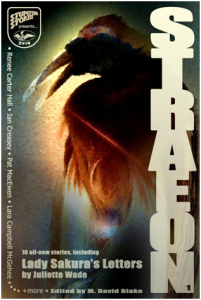
Straeon CoverI’m excited to report that the first issue of the anthology, Straeon, edited by M. David Blake, has finally been released.  It includes my novelette, “Rains of Craifa, Figure 1 – Girl with Shavlas”.  (Just in case you’re wondering, a novelette is a long short story between 7,500 and 17,500 words.  Another FYI — while the following discussion relates what inspired the story and discusses several facets of the theme, it doesn’t include any spoilers. ;))

This is a story I wrote a number of years ago (like many of my writing projects), and it was originally entitled “Rainy Season”.  The title was changed because — not surprisingly — that one has already been used numerous times.  It’s also a positive change since I like how the new one adds a little extra to the story by providing a hint about what happens afterwards.  Also, although some of my own titles are simple, I actually have a fondness for long, elaborate titles, both because they are so distinctive and because they may be quite poetic as well. (A couple of memorable examples I often think of are Delany’s “Time Considered as a Helix of Semi-Precious Stones” and “Stars in My Pocket Like Grains of Sand”; Harlan Ellison has also had quite a few very long and very unique titles that are pretty tough to forget.)

Naturally one of the advantages to pulling out a story after having not looked at it for some time is that it helps you view it objectively. (As I get older I seem to find it easier to do that even if the manuscript in question has only sat for a couple of months . . .  I’m not sure if that’s a good thing or not!  ;)) Being objective also helps make one more aware of things like symbolism. When my sister was studying Literary Criticism for her MA in English and showed me some of her assignments, I confess we laughed over how the serious critics often dissect a story in such depth that the resulting analysis seems absurdly elaborate (and sometimes rather far-fetched).  The ‘lit crit’ folks would probably have a field day with this particular story, as there are many layers of symbolism and many ways in which all the elements tie together.

As I noted in a previous blog post, I find it fascinating that a lot of symbolism comes from the writer’s unconscious mind, rather than being deliberately included during the process of writing.  Certainly I was aware of the basic elements of the theme I was exploring in “Rains of Craifa” involving the transience of life and beauty, like the lyrics of Nino Rota’s “What is a Youth?” from Zeffirelli’s Romeo and Juliet.  But many of the additional layers and details that feed into that theme came as a surprise to me, since I only realized they were there while wrapping up the final edits.

When I was inspired to write “Rains of Craifa” I’d been thinking about Bradbury’s “All Summer in a Day” — specifically, the idea of a place where something only happens briefly and very infrequently, so that if one misses it they may have lost their only chance to experience it.  Clearly that concept can be seen as a metaphor for life itself, and how important it is to ‘seize the day’. (Although in Bradbury’s tale I see that as a secondary theme, while the main subject, IMO, is how children can unintentionally be very cruel.)

The other inspiration that fueled “Rains of Craifa” was a scene in a nature program that showed a frog that spends the dry season looking like a knot of wood on a branch.  Only when the monsoon rains arrive does it transform back into a living, hopping frog, as if magically freed from a spell by the kiss of rain.  And I started thinking about how it might feel to live that way, which in turn led to speculating what it would be like if there were people with a similar life cycle.  So again the ‘carpe diem’ theme and the notion of a brief window of opportunity came into play.

From the first draft one of the things I liked about “Rains” is that I believe it truly captures what travel feels like.  Part of that is the curious sense of obligation — almost guilt — that most travelers feel about seeing and doing the things they’re supposed to do when visiting a certain place.  I.e., when you visit Paris you have to see the Eiffel Tower, when you come to Arizona, you have to go to the Grand Canyon, when you’re in Venice you have to ride in a gondola.  While writing this story I certainly thought about how the fresh perspective provided by traveling can shake someone who’s depressed out of a rut and help give them ‘a new lease on life’.  However, I hadn’t considered how that feeling of being obligated to do certain things when you’re only in a place for a certain period of time is also parallel to completing a bucket list during one’s life journey.

And again, while the issue of becoming depressed and withdrawing from life was always part of the overall theme in “Rains”, that element wasn’t fully developed until my final edits came together shortly before I submitted it.  Then I could see how the story succeeds in conveying how a state of depression can feel like being alive without experiencing life.  But that, of course, is also like spending your existence in a dreamless sleep, as one might do if one truly estivated like a frog through a very long dry season.

While I was partly conscious of the extra symbolism involved in seeing a politician without a face in the opening scene (since their face, i.e. their image and the need to be identified as someone well-known, is a crucial part of their very existence as a political figure), there are other more appealing details that I’m certain I didn’t make a conscious choice about.  One of those is the pervasiveness of autumn colors in the story.  Only recently did it occur to me how much those colors add another nuance of meaning, since the falling leaves of autumn are also a blatant symbol of mortality.

The passage that I’ve always been most proud of in this story (and the one that gives me the ‘Wow — did I write that?’ feeling) is the dream sequence near the end that’s featured in the excerpt I posted on my Short Stories page.  So it’s neat to look at it now and start seeing numerous details that any academic-style critic might easily harvest out of that scene.  For instance, the brown river, being brown like the earth and flowing like the passage of time, is also a metaphor for mortality.  When the river is carrying Valco away on the boat and the girl is left behind, it’s because she seems suspended in time.  But the brown cloth wrapped around her is the same as the river, for she, too, is mortal, and caught in the inevitable flow.  And in the dream the colors of autumn are all around them.

White birds invariably represent something transcendent — something outside of the mundane world.  It’s no surprise that in many cultures white birds are associated with the heavens, peace, purity — concepts that seem above and beyond the earth, since not only can birds fly into the sky, but the stark contrast of their white plumage against the colors of the ground, the plants, and most other living creatures makes them seem untouched by all those earth-bound things.  So with that transcendent quality, here they also represent that moment when you step outside of the inescapable flow of mortality by existing fully in the present as you experience joy and beauty.

I’m sure others can find plenty of additional symbolism that I haven’t seen myself, but finding those elements in that scene was particularly fun.  Incidentally, the most difficult thing about working with this story was that I was always pleased with the last few pages (the dream scene and most of what followed it), but each time I’d reread it and then flip back to the beginning, the opening seemed to lack something in comparison.  To be honest, the ending is still my favorite part.  But in doing the final edits and having the benefit of the input of a skillful editor (thank you, Mr. Blake!), the pieces came together well enough to make me feel confident that it’s a successful story overall.

Though the hypothetical ‘perfect’ story — in which not a word could be altered or replaced without losing something, and each and every sentence reads like an exquisite line of lyric poetry — must be the elusive grail to strive toward, there’s always a special satisfaction that comes at the moment when you can see that in weaving together a collection of words you’ve built something whole that feels like an entity in itself.  (And to me, no story is finished until it’s published, because until that point it’s fair game when it comes to revising and editing.)  But what really gives a completed story meaning is having the opportunity to share it and know that what you’ve made may give others a memorable experience, however briefly.  So I hope many readers (even if they’re not inclined to go digging for symbolism in every line!) will find something in this story that speaks to them.

Genre Definition Revisited: Thoughts on Science Fantasy

It’s occurred to me that my current WIP, The Heart of Elebfar, might be labeled as ‘science fantasy’. Since the entire story takes place on one exotic world, it technically also fits the definition of a ‘planetary romance’ — although it’s certainly not ‘space opera’! But ‘science fantasy’, like many subgenre classifications, can be a bit nebulous, as it essentially just means something that combines elements of both science fiction and fantasy.

Some say science fantasy is fantasy ‘dressed up’ as science fiction, while others say it’s science fiction that includes fantastic elements that are not explained via science. But I think that brings up the question of how much of the science in science fiction is truly explained. It seems that, even in a lot of hard SF, the essence of it is about speculating that a certain premise might be scientifically plausible — either in the future or on another world — more than it is about trying to explain just how it might be plausible.

And if we’re talking about social science fiction, it’s accepted that future technologies or alternate biological conditions may be an essential part of the foundation of the story, but no one expects the author to spend time exploring how those things might actually come about. What’s important is how they would affect human society and the lives of individual humans in that society (as discussed in my previous post about the definition of SF).

One book often named as an example of science fantasy is Gene Wolfe‘s Book of the New Sun. Wolfe incorporates a staggering array of concepts into his works, including many that are never explained and that might seem ‘magical’, and the medieval aspects of the setting and culture of New Sun do lend themselves to a fantasy classification. But as you experience the depth of the world and find references to it being a far-in-the-future earth, the SF elements become more and more apparent. And to me, Wolfe’s other brilliant four-volume novel, The Book of the Long Sun, has far more of science fiction about it than fantasy; I’d say it has a distinctly SF ‘flavor’.

Yes, in Long Sun there’s a character who seems to be a ghost, and another who’s a kind of alien vampire. But I’m left with a strong feeling that just because these things are not explained, it doesn’t mean there isn’t an explanation. What’s more, the books take place on a generation starship, and the androids, vehicles, weapons, etc., (not to mention the way the uneducated people see the figures appearing through some kind of computer monitors as gods) all scream SF to me. So I would argue that this is SF that may contain fantasy elements — and the things that seem fantastical might not be what they seem.

And when I think about Heart of Elebfar — both the story and the world it’s set in — it seems logical enough to simply call it science fiction. There’s no magic, and I see nothing that happens in the book as truly supernatural. Nevertheless, what some might consider ‘fantastic’ are several elements that venture into the realm of the ‘New-Agey’: Reiki-type healing, the idea that gemstones (‘crystals’) could hold and/or help focus energy, and the occurrence of a life-form made from a kind of volcanic stone rather than organic material. There’s also one character who seems to have some kind of psychic abilities — he has visions of things happening in another place or time. But again, although I don’t make any attempt to explain these things, I feel that on this world there is a scientific explanation for them.

Now I suppose we could follow this to the conclusion that on any world in which magic is real, the laws of nature and physics could be different there, so the magic becomes scientifically possible — and is therefore no longer ‘magic’. But I think an important part of what makes a story fantasy has to do with that ‘flavor’, as well as to intent: when it comes to pure fantasy, it’s the author’s intent and the reader’s wish that there be no explanation other than one word: magic. And they would no more want to question that than a child would want to question how Santa Claus can actually get all those presents down the chimney.

One might speculate that Gene Wolfe, being Catholic, subscribes to the belief that there are some very important things that we can’t see or ‘prove’, and that perspective might color his world-building. My own perspective is different since I was raised on science, but I believe one of the best things I gained from that upbringing is an understanding of the importance of keeping an open mind. That includes being open to the idea that there could be real things we have no concept of — and if we saw them, we might interpret them as impossible and ‘magical’, just as our ancestors would have viewed jets and DVD players. So it’s a bit like reaching the same place by taking a different road; rather than having faith in things that can’t be proven, it’s understanding that there may always be something that hasn’t been proven — or discovered — yet. These things might be possible either through unanticipated advances in technology, or through finding other worlds where what we assumed were scientific ‘laws’ are a bit different than they are on this little planet. How can we know otherwise?

And we mustn’t forget that some of the science we were taught as children has since been revised. (Though I have a hard time getting used to the idea that Pluto isn’t a planet, I love knowing dinosaurs were close relatives of birds, and I affectionately call my pet chickens and ducks velociraptors and hadrosaurs.:)) New ideas surface all the time — that’s the nature of science. I’ve seen several programs addressing string theory, though not one of them explained anything beyond a very abstract image of interconnected vibrations, and some confusing conclusions about numbers of dimensions. But some serious physicists have been expending a lot of time and energy exploring this theory, even if others might consider it downright silly.

While I’ll readily admit that much of the talk about crystals having healing energies and such sounds pretty silly, this is an indisputable fact: what looks like a perfectly ordinary rock can be so poisonous that touching it can be fatal. (And, as I understand it, you can even touch that rock and then go touch someone else and make them ill, too.) If something that sounds so fantastic is true, perhaps there could be rocks and minerals in the universe that contain elements with properties we don’t know about yet. So why couldn’t they hold or conduct different kinds of energies, or perhaps even form a different kind of life?

Indeed, these things may be more plausible than Mr. Wolfe’s ‘ghosts’ and ‘vampires’. And since I still think The Book of the Long Sun is better described as SF than fantasy, there seems no good reason to say The Heart of Elebfar isn’t SF, too. Surely the fact that in T.H.O.E. the planet orbits an eclipsing binary star, which results in there being different kinds of daylight depending on the position of the two stars, is an SF premise concerning astrophysics? And doesn’t the fact that I’m exploring the idea that there could be a non-organic life form mean I’m speculating about biology, chemistry, and geology?

So let’s say that we can argue that two of the elements in the story that might seem mystical are actually scientific speculations about the properties of rocks and minerals. And although I’m not aware of any study that has proven that tangible energy can be transferred from one person to another, no one with bona fide medical knowledge would deny that the mind plays an enormous role in the well-being of the body, and the psychological impact of shared physical contact is certainly proven.

That only leaves Farro, the ‘seer’ character. And to me, that unexplained aspect of his character is like one of my favorite things in Le Guin’s The Telling, a book I’m certain qualifies as straight-up social SF. There’s a little mystery that’s referred to in the very last line: “Footsteps on the air.” It’s never explained. But it doesn’t need to be. We can let it stand as a reminder that we should always keep an open mind — in science, in art, and in life.

A Misguided Definition of Science Fiction — And Why I’m Proud to Write ‘Girly SF’

There’s been a lot of discussion this week about Paul Cook’s post at Amazing Stories, in which he pontificates on why a lot of science fiction actually isn’t science fiction.  I just read a great post summarizing much of this discussion on Cora Buhlert’s blog.  While I agree, as most do, that Mr. Cook has every right to his own opinion, I also agree that the manner in which he expressed it was offensive.

Whether or not it was unintentional, the article does come across as sexist, and as a big Gene Wolfe fan, Paul Cook’s disparaging attitude toward Wolfe’s work certainly didn’t impress me either.  (He also made the error of claiming that Wolfe’s brilliant tetralogy, The Book of the New Sun, shows the influence of Orson Scott Card, when Card’s work actually came after New Sun.)

One line in Cora Buhlert’s blog post about the reactions to Paul Cook’s discourse particularly struck a chord with me.  While discussing the prejudice against human relationships — both emotional and physical — and the apparent distaste for the human body itself in much hard SF, she remarks about the “dearth of sex, childbirth and descriptions of food” in science fiction.  This made me think of several things I find significant.

The first is that this is similar to what Ursula K. Le Guin was talking about in her essay, “Science Fiction and Mrs. Brown”.  (I just looked at my copy of The Language of the Night, and it says that essay was written in 1976 — which would suggest that some things haven’t changed much in nearly forty years.)  In turn, recalling that essay brought to mind Vonda N. McIntyre’s Starfarers.  There’s actually a character in Starfarers whose name is Mrs. Brown — an elderly woman who epitomizes just the sort of character you wouldn’t expect to find on a starship — and I’ve wondered if that’s a coincidence or a deliberate homage to Le Guin’s essay.

In any case, per Le Guin’s definition, the four books in McIntyre’s Starfarers Quartet feature plenty of ‘Mrs. Browns’.  That is, well-rounded human characters — the kind of characters who have realistic human experiences during their journeys.  But Starfarers still qualifies as hard SF — I’ve often seen it labeled that way, and it was reviewed on a site that goes by that name.  Of course it’s about space exploration, and biology is one of the sciences McIntyre explores a great deal in this book — which is not surprising since she has a ‘real life’ background in biology and genetics.  And these ‘natural sciences’ are considered ‘hard’ sciences. (Although I’ve seen one definition of hard vs. soft science that describes biology as ‘intermediate’, for what it’s worth.)

I’ve read reviews of Starfarers that complain that the story moves too slowly because of the heavy focus on familial relationships and politics.  But all that time spent showing the human relationships and their true-to-life aspects — not only passionate kisses and tender backrubs, but the little things people share that enrich life, like the enjoyment of tea, smoked salmon, and silk shirts — is probably what I like best about the book.  (Okay, that and the fact that there’s a herd of miniature horses running around in the fields on the ship!)

When naming books that one might compare to my own SF novel, In the Shadow of the She-Wolf, McIntyre’s Starfarers Quartet comes to mind largely because of the way the relationships and their life-like details are at the forefront of the story.  In particular, some might see similarities in the third volume of She-Wolf, where much of it takes place onboard a ship and the conflicts also involve family relationships and politics.  (And come to think of it, although there isn’t much sex in She-Wolf, I doubt anyone could find it lacking when it comes to childbirth and descriptions of food.) 😉

Incidentally, I suppose it’s a natural part of my obsession with realism that as a reader — and, consequently, as a writer too — I love the inclusion of passages about food.  In the very first version of the manuscript that eventually evolved into She-Wolf, my favorite scene was the one I called ‘the food scene’.  A trillion drafts and a gazillion years later, I still love that scene.  The aspect of culture shock that involves strange foods can be humorous as well as uncomfortable; while illustrating one of the fundamental difficulties of adapting to a new culture, it also provides fodder for comic relief.  (There’s another dining scene in the final volume of She-Wolf that facilitates one of my favorite lines of dialogue in the novel: “Well, we’ve sure opened a mess of worms, but they haint in your lunch.”)

Of course, according to Paul Cook, everything I write is ‘girly SF’.  Unlike McIntyre, I have no training in hard sciences — I studied anthropology instead.  Sociological science fiction is ‘Soft SF’ by definition, because the sciences involved are those that are defined as ‘soft’: anthropology, psychology, political science, etc.  In the Shadow of the She-Wolf focuses on all of these, and I would readily describe it as a very ‘psychological’ novel; for example, the experience of culture shock features very prominently in the book.

In She-Wolf, the high-tech culture uses FTL travel and an extremely powerful kind of ‘directed energy’ weapon.  But these elements function — as is typical in sociological SF — as a backdrop to the story, and  I don’t profess to have any clever theories about how these technologies might work.  I can say that the concept of the weapon is very loosely based on an article I read about new ideas for weapons the military is working on, and that, unlike many SF weapons, it’s definitely not a laser; I visualize this ‘directed energy’ as something more like a captured lightning bolt.  Only, you know . . .  different.  (And if you want to know what this weapon does, you’ll just have to read the book.) 🙂

There’s another thing that lamenting the ‘dearth of sex, childbirth and descriptions of food in SF’ made me think of, and it’s nothing less than a big part of what inspired me to want to write my own books to begin with.  As I mention in my bio here, by the time I started my first novel at age eleven, I knew I wanted to tell stories in which fantastic things happen (whether they involve magic and dragons, or travelling to mysterious planets filled with alternative life forms), yet I wanted to tell them in the way that my favorite ‘real life’ stories were told, with those little intimate details that make a reader feel like they’re actually there, experiencing each moment themselves.

To me, this is what makes the difference between just being told a story about someone else — and perhaps being introduced to an interesting idea or two — and being drawn into a story that enriches you in a way you’ll never forget, leaving you with the feeling you’ve travelled to another world yourself.   Without the human element — yes, all that pesky business about sex, childbirth, and food — you won’t make the trip.  That other world will remain distant and abstract; it will just be a ‘fantasy’.

If Paul Cook can say that SF that strives to recreate the human experience — complete with all the messy stuff — is fantasy or romance and not real SF, I shall assert my own opinion that, au contraire, it’s the kind of SF that’s the most real.  And while Mr. Cook can extol the virtues of his macho ‘sciency’ SF, I’ll keep my ‘girly SF’, thank you very much!